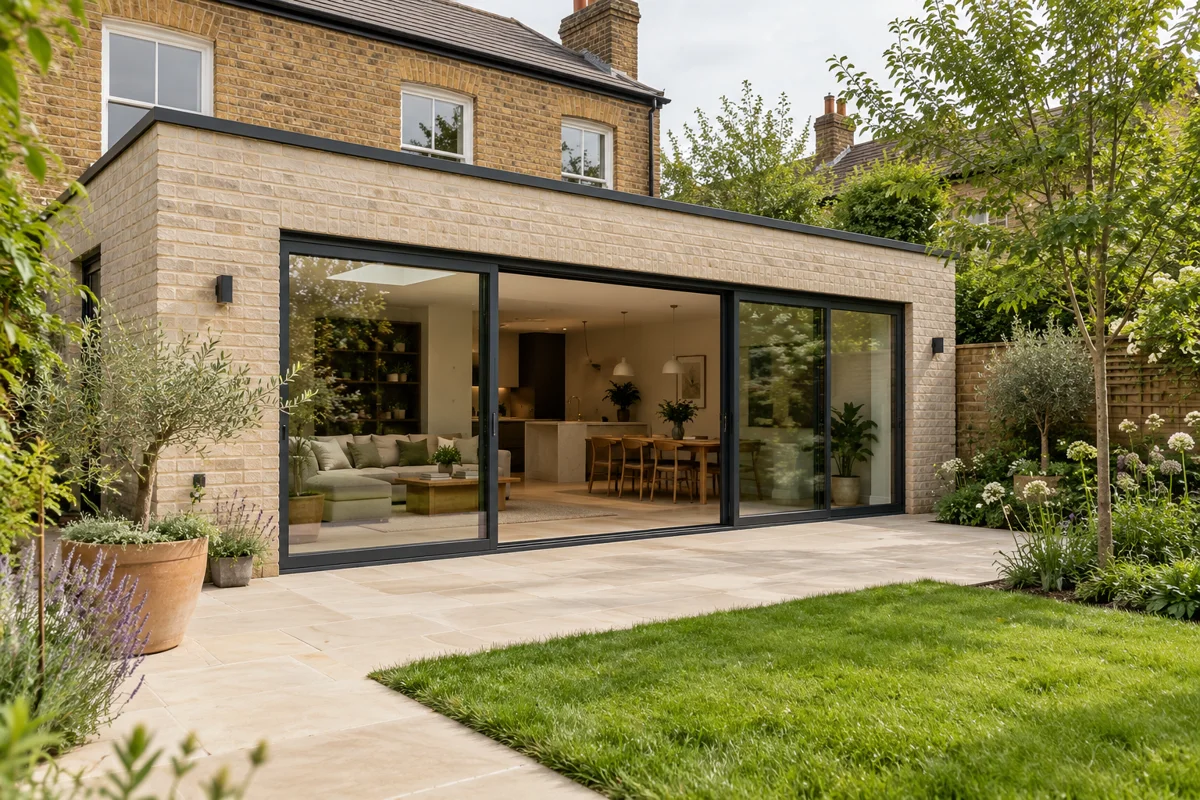
Start with the finish line
Write down what “finished” means before comparing prices. A watertight shell, a plastered room and a furnished kitchen extension are different products. Specify glazing, heating, electrical points, floor finishes and decoration. Ask each builder to price the same scope.
- Record the floor area and drawings used for the quote.
- List owner-supplied items separately.
- Ask how variations will be agreed and recorded.
Keep five budget lines
Use separate allowances for design and surveys, the main build, fit-out, temporary arrangements and contingency. Design costs do not disappear because they are outside the builder’s contract. Temporary cooking, storage or accommodation may matter if the work affects the room you use every day.
- Put known additional work into extras, not into contingency.
- Check if every line is before or after VAT.
Compare a worked scenario
For illustration only, 25 m² at £950/m² materials and £650/m² labour, 10% materials waste and £5,000 extras gives £47,375 before contingency and VAT. With a 10% reserve and 20% VAT the modelled total is £62,535. These are chosen scenario inputs, not a claim about average UK building prices.
Check approvals separately
Building regulations approval and planning permission are distinct. Confirm the requirements for your nation and project with the relevant authority before commissioning work. The calculator does not assess whether the proposed extension is permitted. A professional site assessment also helps identify structural and service constraints.
Agree a change process
Ask who can approve changes, how they are priced, and when you will receive an updated total. Keep written quotations and a running schedule of additions. A reserve is useful only if you can see when it is being spent. Avoid treating the first rough area estimate as a fixed contract price.
Sources & methodology
- GOV.UK: building regulations approval
Planning permission and building regulations approval are distinct. Check the applicable nation and local authority.
Checked 8 Oct 2026